The A350 ATA 45 OMS centralizes all aircraft health monitoring, BITE diagnostics, condition monitoring, and software loading into a unified avionics framework.
Hardware is split cleanly between the certified Avionics Server Function Cabinet (ASFC) and the Open World Server Function Cabinet (OSFC).
Secure Communication Interfaces (SCIs) provide unidirectional data diodes and cryptographic verification, isolating flight avionics from maintenance networks.
The Airbus A350 Onboard Maintenance System (ATA Chapter 45) represents the pinnacle of commercial aviation maintenance digitalization. Seamlessly integrated into the Integrated Modular Avionics (IMA) environment, the OMS consolidates diagnostic built-in tests, operational flight condition trending, and software configuration management into an intuitive, paperless maintenance interface.
1. The Evolution to Centralized Onboard Diagnostics
From Federated Line Replaceable Units to Shared IMA Architecture
In legacy airliners, each electronic box managed its own isolated Built-In Test Equipment (BITE). Maintenance personnel often had to correlate disparate fault lamps, access multiple test panels in electrical bays, and manually transcribe fault codes onto paper maintenance logs.
The A350 redefines this paradigm by hosting maintenance applications inside shared computing cabinets. All system components continuously report status, internal voltages, calibration drift, and discrete sensor target states to a centralized maintenance engine.
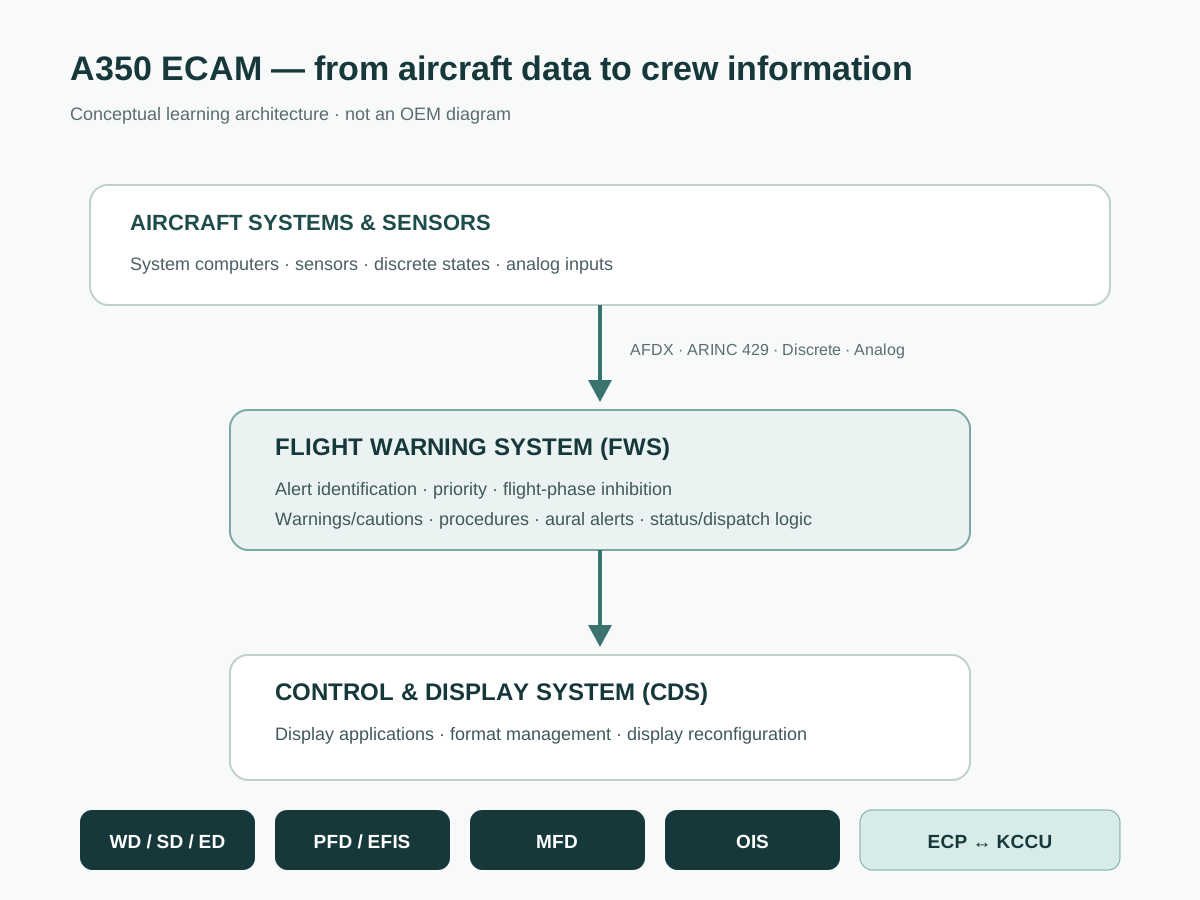
Figure 1: Airbus A350 OMS connectivity with IMA Core Processing Modules and Cockpit Displays.
⚠ Avionics Domain Segregation
The OMS enforces strict hardware separation: CMS-ACD operates within the ASFC avionics domain, while technician portals operate in the OSFC Open World domain behind hardware-enforced Secure Communication Interfaces.
2. The Four Pillars of A350 OMS
CMS, ACMS, DLS, and the Integrated Electronic Logbook
1. Central Maintenance System (CMS): The central intelligence responsible for fault capture, symptom filtering, flight phase correlation, and generating the authoritative Post Flight Report (PFR).
2. Aircraft Condition Monitoring System (ACMS): A dedicated thermodynamic and mechanical data recording engine tracking Trent XWB engine gas path health, APU start cycles, and airframe structural accelerations.
3. Data Loading System (DLS): An ARINC 615A/665 compliant software distribution network that enables uploading avionics operational software and navigation databases from a centralized mass storage server.
4. Electronic Logbook (eLogbook): A synchronized digital interface allowing pilots and technicians to log defect notices and view automated deferral limits per the Minimum Equipment List (MEL).
By fusing avionics fault correlation with predictive condition monitoring, the A350 OMS reduces unnecessary component removals by over 40% and provides ground technicians with precise troubleshooting steps prior to aircraft arrival.
Technical Review & Part-66 Comprehension Check
Q1: What are the three primary subsystems that constitute the Airbus A350 Onboard Maintenance System (ATA 45)?
Q2: How does the A350 protect flight-critical avionics from maintenance network cyber vulnerabilities?
Q3: What is the primary operational advantage of the A350 centralized OMS compared to legacy federated BITE systems?